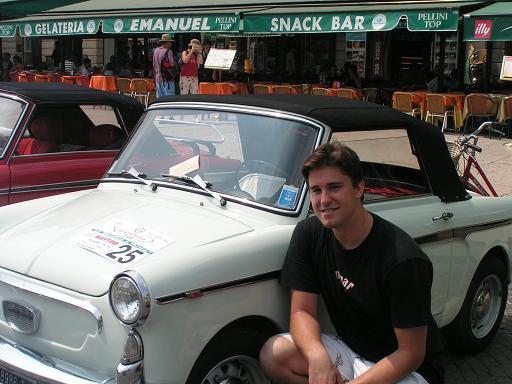
First off, le cuisine de la France est peut-etre assez bizarre pour un americain. Despite the fact that you may be freaked out by the very idea that French people eat what they eat while maintaining tight control over their collective gag reflexes (they actually seem to enjoy it!), it is good for an American to dive into French cooking head – mouth? – first. After all, the fact is that people do eat these things every day, no one has died yet, and if you get caught up on the difference between what you are used to and what is normal in France, you’re likely to create a self-fulfilling prophecy on the assumption that the food is simply too weird. In general, it might behoove you to go to a restaurant, point at the menu, eat, enjoy, and look up just exactly what it is you ate after you get back home.
I used the word “restaurant” in the previous paragraph, but it ought to be known that there are several types of eateries in France, offering many different cuisines, all of which have their fierce partisans. In point of fact, a restaurant, or “resto,” is a fairly formal dining experience. It is always a sit-down place, the service tends to be slow with the expectation that the patrons will take their sweet time to enjoy the many courses. A “bistro” tends to a small, mom-and-pop type of organization, and along with cafes, this is where Parisians go to eat most often. These generally serve traditionally Parisian fare (more on that later). The aforementioned cafes are similar, but they tend to have quite a short menu and offer prix-fixe meals at very good prices. Common selections include salads, crudités, steak et frites. I find that cafes are actually best for a relaxing break in between destinations or activities; order a bottle of water or the most expensive thing on the menu, and you can “camp out” for as long as you like. Unless the place is closing, don’t count on someone asking you to leave. Bieres a la pression are also genially offered here, despite the fact that beer seems to be looked down on elsewhere, in favor of, naturally, wine. Brasseries are café-type places that are generally open early and closed late. Traditionally, they specialize in Alsatian fare, although the word is being used for more mundane cuisine quite often.
But what do they serve? Is it true that they eat frog’s legs and snails? Mais oui! And more, in fact. Here is a sampling of some traditional Parisian and/or French food.
- Andouillette: this is a sausage of pork organs cooked in the intestine. It is much better than it sounds. Look for the stamp “AAAAA” for the best Andouillette.
- Fruits de Mer: Literally, fruits of the sea, this usually comes on a large, layered tray filled with ice. You’ll find oysters, clams, shrimp, sometimes crab, and generally always mussles and periwinkles.
- Escargots: Snails, cooked in garlic. Go ahead, you know you should at least try it, even if it does give you the impression that you’re chewing Wrigley’s Garlic Gum.
- Cuisses de grenouilles: Frogs’ legs, another quintessentially French meal.
- Boudin: a sausage made from pig’s blood, roughly comparable to the “pudding” served in England. I haven’t had this, but it is supposed to sweet and very rich.
- Foie Gras: Engorged duck liver, served as a pate and generally expected to be spread on warm toast. Delicious.
- Bouillabaisse: a bit different from the Cajun-inspired New Orleans version, this is still, however, a stew made from fish, shellfish, croutons, cheese, and a few other ingredients. This is always good, especially for the poisson lover.
- Carpaccio: Thinly sliced raw meat or fish, generally tuna. If you have a problem with raw meat, don’t go here. Which brings me to:
- Steak Tartare: Raw ground beef, seasoned with egg. Expect it to be just-killed fresh.
- Boeuf Bourguignon: this is a Parisian staple; it is beef in burgundy wine, onions, and mushrooms. It is quite rich, like most French food, and it is very good, especially for the more timid eater.
- Choucroute: sauerkraut – this is a very Alsatian dish (history buffs will know that Alsace, and its partner, Lorraine, borders Germany and has in fact changed hands between the countries multiple times), and it has a distinctively German flair. Expect it to be garnished with potatoes perhaps sausage, and have a large joint of pork on top, probably with the bone and skin still on. Very good!
- Confit de canard: duck meat preserved and cooked in its own fat; once the outer fat layer is scraped away, you’ll find the meat underneath very juicy and delicious.
And in case you were wondering from the title, the French do indeed eat sheep or pig brains on occasion. These are called cervelles. Likewise cheval is horse meat, but it’s fairly hard to find. Not even I am bold enough to try these.
In case you are a smoking Nazi, France is not the place for you. Smoking is accepted and hardly separated from les espaces non-fumuer. Don’t be surprised to see someone light up right next to you. Likewise, if you do not like dogs, you might be in for an unpleasant surprise. Chiens are welcome inside all but the most formal restaurants, and it is quite common to see a Parisienne leading a cute little dog inside the café, and perhaps even feeding or watering it from the table.
Perhaps I’ve managed to scare you away from French cuisine by being upfront about it. But if this is the case, I would suggest that you bear in mind the fact that the French are world-renowned as epicures; their taste in food is widely imitated and their dishes considered delicacies nearly everywhere else in the world. Don’t you think there is perhaps a reason for this? And aren’t you curious to know what it is?
 therewith. It's a Suzuki GSX750F Katana (I call it the Kan-a-tuna, lovingly of course). At least, in Les Etats-Unis it is. I found one in Europe, which was a bit of a trip, since they're very much into the naked-bike thing here, and I've seen several GSX750's (sans F) - the unfaired kind that were never offered in the States. In Europe, the thing is called the Slingshot. Interesting name for a motorcycle, and not just because it makes no sense in the indigenous language; after all, what does it describe? The action you might take if you rearend a Smart Car?
 therewith. It's a Suzuki GSX750F Katana (I call it the Kan-a-tuna, lovingly of course). At least, in Les Etats-Unis it is. I found one in Europe, which was a bit of a trip, since they're very much into the naked-bike thing here, and I've seen several GSX750's (sans F) - the unfaired kind that were never offered in the States. In Europe, the thing is called the Slingshot. Interesting name for a motorcycle, and not just because it makes no sense in the indigenous language; after all, what does it describe? The action you might take if you rearend a Smart Car?


 So, as I was saying, my sister and I raced to the last train to Verona (we had already missed our earlier one), and made it with about 20 seconds to spare. An hour and a half took us to a quaint northern Italian village, where my sister is staying in a monastery. It's better than it sounds.